CNC + SLA hybrid
Printed in resin, finished on the CNC
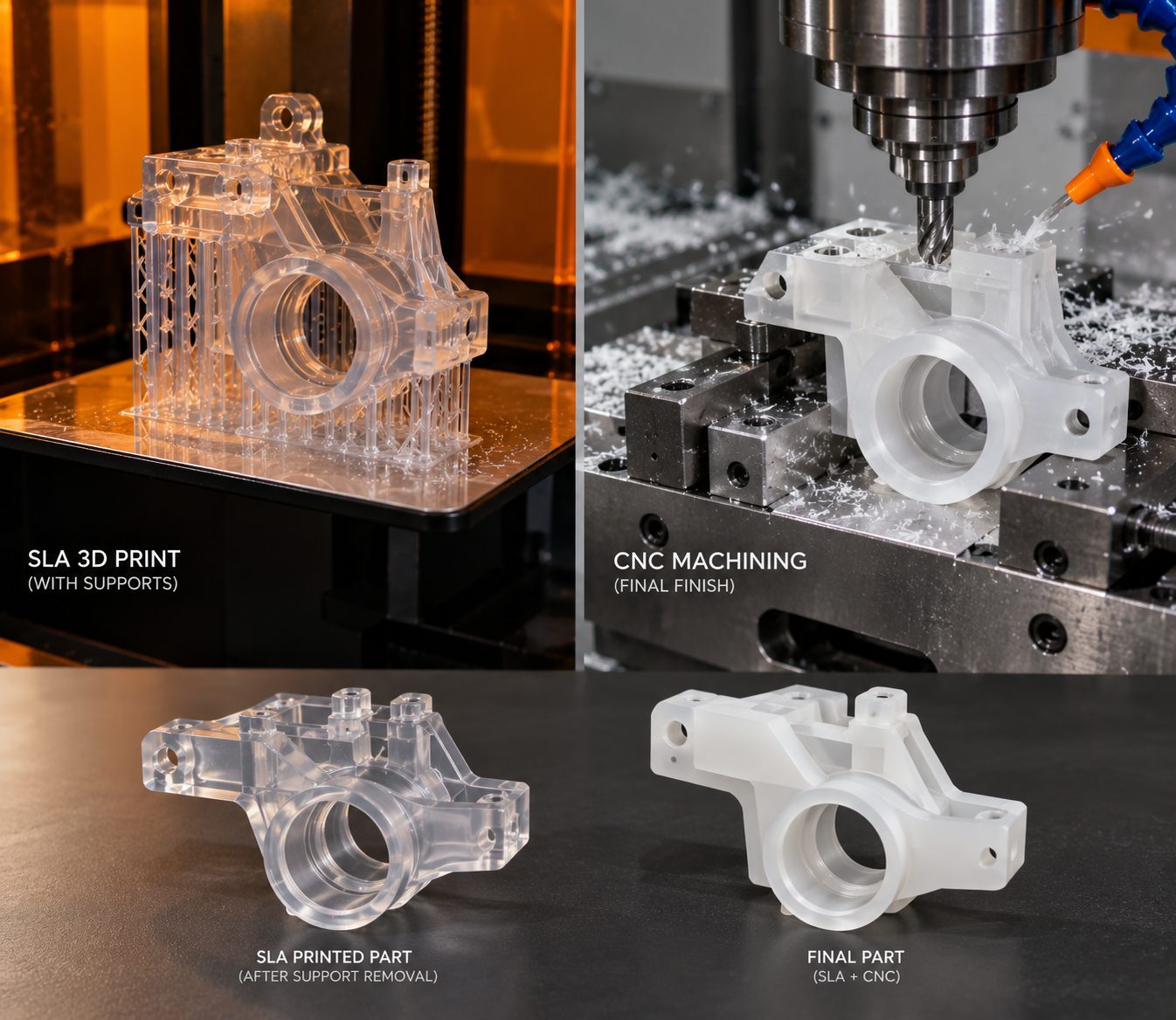
The shape comes off the printer overnight. The features that have to fit are then machined, so you get the detail and price of a print with the accuracy of a machined part where it counts.
How it is made
Four stages, one part
Most print shops stop at the printer. We add a CNC stage, so a resin part can leave with machined bores, flat mating faces and real threads instead of a compromise.
- 01
Print with supports
The housing is printed in resin with extra stock left on every critical feature.
- 02
Wash, cure, remove supports
Fully cured so the part is stable and stiff enough to hold in a vice.
- 03
Machine what matters
Bores reamed, mating faces skimmed flat, holes drilled and tapped or fitted with inserts, to ±0.01 mm.
- 04
Inspect and ship
Critical dimensions checked against your drawing before the part leaves.
- Machined features
- ±0.01 mm
- Printed body
- ±0.1 mm
- Added lead time
- +1 to 2 days
What we machine on a print
The features that have to fit
A resin print holds ±0.1 mm on its own. These are the features we take further on the CNC, so the part fits a bearing, a shaft or a mating housing first time.
-
Bores
Printed undersize, then drilled and reamed for bearings, bushings, dowels and shafts.
-
Mating faces
Faces skimmed flat and square so housings seal and stacked parts sit true.
-
Threads and inserts
Tapped threads for light duty, heat-set or threaded inserts where a screw is torqued repeatedly.
-
Slots and datums
Keyways, locating slots and reference edges cut to size so the part locates the same way every time.
- Choose hybrid when
- A printed part needs one or more features better than ±0.1 mm
- Choose resin alone when
- Nothing has to fit tighter than a print already does
- Choose solid CNC when
- The part needs metal strength or heat resistance throughout
Where it pays off
Housings with bearing seats, sensor mounts with a datum face, brackets that bolt to a machined frame, jigs that locate on dowels. The printed body carries the shape, the internal channels and the cosmetic surfaces; the CNC pass makes the two or three features that decide whether the part fits.
Where it does not
If every surface has to be accurate, or the part sees sustained load or heat, machine it from solid. If nothing has to fit closer than a print already does, plain resin is cheaper. Send the part and we will tell you which.
Same file, more parts
Because the machining is a short second operation on a printed body, the same file scales from one prototype to a batch of hundreds without a redesign. The fixture and programme stay on file for repeat orders.
How to order
Price it as resin, mark what to machine
The instant quote covers the printed body. The machining is a short extra operation that we price by hand from your drawing and confirm with the quote.
Price the print
Upload the STL in the quote tool and choose a resin. The instant price covers the printed body.
Mark the features
On a drawing or in the notes, mark the bores, faces, threads and slots to be machined, with the tolerance for each.
Confirm and make
We add the machining cost, confirm the final price within one working day, then print, cure and machine the parts.
Materials
Resins we machine
Tough resin machines best and is the default for hybrid parts. Standard resin is fine for light-duty housings; ESD resin for parts near sensitive electronics.
| Material | Process | Properties and typical use |
|---|
Have a part ready?
Upload an STL and see the price straight away. Your file is measured in your browser, so nothing leaves your computer until you choose to send it.